Key figures of the climate change mitigation activity
Deutsche Gesellschaft für Internationale Zusammenarbeit (GIZ) GmbH
Thailand
Farmers in Chaiyaphum, Saraburi, Nakhon Nayok, Phitsanulok
In development
Rice is Thailand’s most important food crop, covering around half of Thailand’s agricultural and supporting the livelihood of circa four million farming households. Yet rice farmers are among Thailand’s most economically vulnerable groups and are increasingly affected by changing weather patterns, longer dry periods and rising temperatures. Many lack the financial resources, technical support, and access to innovative revenue streams needed to adapt.
At the same time, traditionally irrigated rice fields generate significant methane emissions. The mitigation activity promotes Alternate Wetting and Drying (AWD), a proven irrigation practice that allows fields to dry periodically instead of remaining permanently flooded. AWD introduces oxygen into the field, which reduces the conditions that produce methane while also improving water efficiency.
Implemented by GIZ in at least four provinces in Thailand, namely Phitsanulok, Saraburi, Nakhon Nayok, and Chaiyaphum, the mitigation activity aims to train 30,000 rice farmers in applying AWD and complementary climate-smart agricultural practices. These include improved nutrient, pest, straw and stubble management.
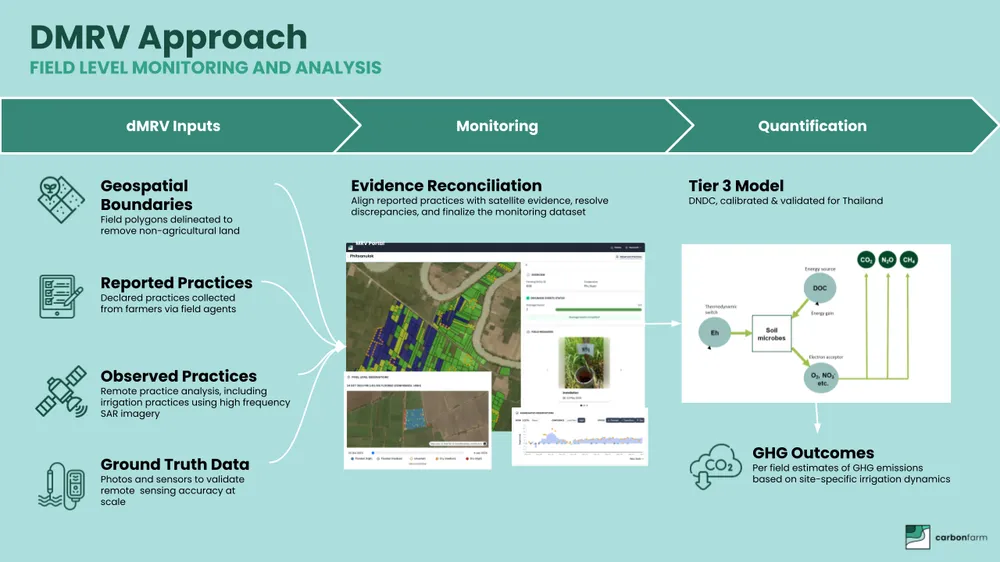
The Mitigation Activity uses a tier 3 DeNitrification – DeComposition (DNDC) model and implements a robust digital Monitoring, Reporting and Verification (MRV) system through the CarbonFarm’s digital platform. Monitoring combines field-level data with satellite-based remote sensing.
Financed by the KliK Foundation, the mitigation activity addresses technical, knowledge and financial barriers that currently limit AWD adoption in Thailand. The activity specifically targets farmers and project areas that are not covered by existing or planned AWD initiatives. It is designed exclusively as an Article 6.2 activity and does not form part of the country’s unconditional or conditional NDC contributions, ensuring that Thailand’s ability to meet its climate targets is not affected.
Beyond reducing methane emissions, the mitigation activity creates tangible benefits for participating farmers and the environment. Through Alternate Wetting and Drying, farmers gain greater control over irrigation and avoid unnecessary water use, reducing both water consumption and pumping costs.
Combined with climate-smart agricultural practices, AWD makes rice production more resilient to water scarcity, delayed rainfall and climate variability. Periodic drying can reduce certain water-related pests and diseases, lowering the need for chemical pesticides. It also improves soil aeration, supporting root development, nutrient uptake and soil health.
Farmers receive practical training in AWD, complementary climate-smart practices and data management, strengthening their knowledge and capacity to manage their farms sustainably. They can also benefit financially through lower irrigation and fertiliser costs and direct payments from the mitigation activity’s benefit-sharing mechanism, which distributes a share of carbon revenues to participating farmers.
These co-benefits contribute particularly to SDG 2 by supporting resilient production and higher farmer incomes, SDG 3 by reducing air pollution through less open-field burning, and SDG 6 by improving water-use efficiency.